
8/27/26 – Rays Stadium Funding Vote
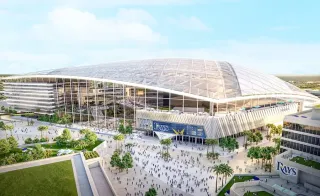
This week it’s all about the Rays stadium vote at Thursday’s regular meeting.
This week at a glance
- Regular Session
Update, Wednesday 8/26: less than 24 hours before the vote, the Clerk posted a memo from the City Attorney sent to Council with substitute versions of all three agreements. The tax-sharing formula in Exhibit E, the $80 million payment terms, the Downtown CRA language and the Drew Park CRA all changed. The tables and dollar figures below are based on the Friday version and are now out of date. I’ve left them as written; the changes and updated numbers are in The Rays agreement was rewritten the day before the vote.
Apologies for the lack of an agenda preview this week. All of the attention will be on the Rays vote this week anyway, item 80 on the agenda, so instead I’ll leave you with one last attempt at putting the Rays stadium proposal into perspective.
The Stadium Vote
I started writing something before the funding agreement was released Friday evening, based on the media stories that the city would “loan” $80 million to the Rays and that the city would be paid back through tax revenue from the multi-use development portion of the Rays project. What the funding agreement actually outlines is that the city will still give the Rays $80 million in 4 annual $20 million installments starting January 1, 2027. It’s not a loan. It doesn’t specify which tax revenue the city uses, it doesn’t have to be Community Investment Tax (CIT), but it’s $80 million in city funds. Good thing there’s more than $40 million set aside this year in the budget in case Amendment 3 passes. Though I’ve read quotes from the mayor that the city won’t use CIT funds and might borrow money to fund the city’s contribution. Surely that will be clarified before they vote, right?
The Drew Park CRA boundary with the three publicly owned parcels highlighted in blue — part of the toolshed maps collection.
Additionally the “Stadium District” would be carved out of the Drew Park CRA as widely reported. A Community Development District (CDD) would be created in its place. Within the funding agreement there’s an outline of how Incremental tax would be distributed. A formula based on Taxable Assessed Value (TAV); as the district’s TAV increases, the CDD gets a larger portion of the incremental tax.
| District TAV | City + County | Stadium CDD |
|---|---|---|
| Below $350M | 70% | 30% |
| $350M – $650M | 50% | 50% |
| Above $650M | 15% | 85% |
Exhibit E in funding agreement
What’s missing from that equation is exactly what would be built, how the ground lease will work, and any supporting financial documents from the Rays (the agreement does specify they have to provide them to the city before the funds are secured, apparently they don’t need to be part of the decision making process on the funding.) I began evaluating how a loan could be repaid from incremental tax revenue when the idea of a $100 million CRA loan was presented. I first estimated the size of the development using the raw 121 acres of the parcels the state gave away. Subtracting for the college, stadium and parking, that leaves 70 gross acres for mixed-use development. As a comparison, I looked at Channelside as a realistic level of density that could be developed across that size of development. Channelside took close to 20 years to reach its current level of development with a current $7.06M TAV per gross acre.
A note about the model and tables. Since the land is public currently, it’s TAV is $0 and the model skips the $0 years. Year 1 of the ramp is whenever the first buildings are assessed — 2030, give or take — and the 30-year clock in these tables runs from there, not from the 2026 agreement date. Also, the model holds FY26 millage flat for all 30 years. I also factored in 3% annual market growth. All data pulled from the Hillsborough County Property Appraiser.
20-year ramp at Channelside density, 3%/yr growth, both millages:
| Year | Taxable value | Total collected | City | County | District |
|---|---|---|---|---|---|
| 1 | $25M | $0.29M | $0.11M | $0.09M | $0.09M |
| 5 | $139M | $1.62M | $0.60M | $0.53M | $0.49M |
| 10 | $322M | $3.76M | $1.40M | $1.23M | $1.13M |
| 11 | $365M | $4.26M | $1.13M | $1.00M | $2.13M |
| 16 | $616M | $7.18M | $1.91M | $1.68M | $3.59M |
| 17 | $674M | $7.86M | $0.63M | $0.55M | $6.68M |
| 20 | $866M | $10.11M | $0.81M | $0.71M | $8.59M |
| 30 | $1.16B | $13.58M | $1.08M | $0.95M | $11.55M |
| 30-yr total | -- | $208M | $29M | $25M | $155M |
It was suggested to me by Council Member Bill Carlson that the development would be closer to Midtown level density (roughly double Channelside, $13.4M per gross acre) and built in 10 years. Midtown being less than 1/3 the size of Channelside with limited public spaces. I find it incredulous that something 3x the size of Midtown would be built by 2038-2039.
But for the sake of argument, let’s give the density claim every benefit of the doubt and use Water Street instead of Midtown. It’s denser — $15.8M TAV per gross acre today, and that’s with it only partly built — and at 56 gross acres it’s much closer to the size of the 70 acres in question. Never mind that a decade in, with the deepest pockets in town behind it and $100 million in public contributions, $50 million each from the city and county, Water Street still isn’t finished.
So: 70 acres at Water Street density, built in 10 years.
10-year ramp at Water Street density (~2.2× Channelside per gross acre), 3%/yr growth, both millages:
| Year | Taxable value | Total collected | City | County | District |
|---|---|---|---|---|---|
| 1 | $111M | $1.29M | $0.48M | $0.42M | $0.39M |
| 3 | $352M | $4.11M | $1.09M | $0.96M | $2.05M |
| 5 | $622M | $7.26M | $1.93M | $1.70M | $3.63M |
| 6 | $769M | $8.98M | $0.72M | $0.63M | $7.63M |
| 10 | $1.44B | $16.84M | $1.34M | $1.18M | $14.31M |
| 20 | $1.94B | $22.63M | $1.81M | $1.59M | $19.24M |
| 30 | $2.61B | $30.41M | $2.43M | $2.13M | $25.85M |
| 30-yr total | -- | $551M | $48M | $42M | $460M |
Even in that extreme scenario, the best the city would see is $48 million against the $80 million contribution and it would primarily be in the out years. Meanwhile, once the TAV hits $650M, the bulk of the funds are going to CDD. That’s the case regardless of market growth and density. What we don’t know is how the city/county/Rays intend to use those funds. It’s strongly suggested they will be used for a bond (in the media, a second $100 million loan was floated, after calling the $80M contribution a loan as well.)
The other part of the equation in the funding agreement is that along with carving the Stadium District out of the Drew Park CRA district is capping the city’s required contribution to the Downtown CRA districts at 50%.
| Downtown District | FY24 actual | FY25 actual | FY26 revised | FY27 budget |
|---|---|---|---|---|
| Core CRA TIF Contribution | $7.59M | $7.51M | $8.35M | $8.32M |
| Non-Core CRA TIF Contribution | $19.32M | $20.27M | $21.21M | $21.22M |
| Total | $26.9M | $27.8M | $29.6M | $29.5M |
Half of that is ~$14.8M/yr at today’s values; ~$240M flat or ~$300M at 2.5%/yr growth over FY2028–2043 if the cut applied to the whole line. The way I read the agreement however, that doesn’t mean 50% comes off the top, its 50% off after all existing obligations are secured. Existing funding agreements and development agreements like Gas Worx or the Convention Center debt. I estimate that would look like $7 million in FY28 and $45-$50 million over first 5 years of the cap. Funds that would go into the general fund.
Additionally, West Tampa, Drew Park and East Tampa CRA districts would each be extended another 30 years.
Tampa’s ten Community Redevelopment Areas — part of the toolshed maps collection.
But that still doesn’t change that “we” are giving away 121 acres of public land claiming there’s nothing else that can be done with it and that the college campus is a lot of wasted space. I think that’s some extremely small minded thinking. If the state and HCC had put out a Request for Proposal (RFP) for a mixed-use development to be incorporated with a re-imagined Hillsborough College leaning into the industrial zoning that still exists in Drew Park, one could picture a college focused on cutting edge manufacturing technology that anchored a thriving ecosystem of a different kind of technology entrepreneur. Lifting up the entire Drew Park district. If you want to wrap yourself in a flag you could point to MacDill AFB literally a couple of miles down the road and already see what’s happened around Ybor with defense contractors. But that’s just one idea.
Instead, we’re going to get a shell of a college campus that is focused on “hospitality” and “sports medicine” so they can be used as cheap labor under the guise of internships for the Rays and their stadium facilities. Real visionary stuff I tell you.
And finally, all of the Tampa talk recently has taken the focus off the county who are providing the bulk of the public funding – $796 million. $360 million in CIT that should have gone to the school district but everyone decided the city and county needed those funds more than schools (in the original CIT, the school district received 25% of the tax. The renewed CIT is 5%). That we need to fix roads and build police and fire stations instead of building schools or improve air filtration or what ever else one of the largest school districts in the country needs that the state is depriving them funding for. And in less than a year, a majority of those same public officials are ready to hand that money over to a billionaire to build a private baseball stadium. I mean, for public infrastructure that just happens to be in conjunction with a private stadium.
Following along from home? Check out Stadium Booster Talking Point Bingo and play along Thursday.
Our stories may be republished online or in print under Creative Commons license CC BY-NC-ND 4.0. We ask that you edit only for style or to shorten, provide proper attribution and link to our website.