
10/1/26 – First formal votes on proposed Charter amendments
Flagged items from a 67 item regular agenda with the first formal votes on proposed Charter Amendments this week. Plus a note from the editor.
This week at a glance
- Regular Session
A Personal Note
Last week someone said to me “I’m not sure why you do what you do” and I joked I’m still trying to figure out which of my past sins put me on this path but I guess I’ve committed to it. What it is I’m still trying to figure out. I started this site to collect public data and experiment with pulling it together after an experience volunteering on a project at a national scale. Among the many invaluable lessons I learned on that journey was to go back to the local level. Go to where the work is being done. The search to find that led me to following council meetings and learning exactly how many of the issues today — housing, mobility, food insecurity — (that will get me dinged by the AI detector) all run through the agenda. And at the time, the online agenda really sucked. I’ll spare the history lesson but that’s how I began this. Trying to build a better mousetrap from the outside. And I think it’s more important to know about something before action is taken than after.
As an aside, one of my biggest inspirations along the journey was Jennifer Pahlka. I recently read something she wrote this past spring about a Three Horizons Framework for Government Reform that reminded me of that early work I did and what I was hearing from folks doing the work and how it probably relates to what a lot of the people who might read Tampa Monitor feel about trying to make change.
A lot of what the government reform field has built over the past fifteen years, including a lot of my own work, is probably H2-. Not because the people doing it were wrong, and not because the work didn’t matter, but because the structure of the work, no matter how well executed, had a systematic tendency to solve the immediate problem in a way that made the structural problem easier to tolerate. If that sounds like an indictment, the first place I’d point the finger is at myself. And I don’t regret any of it. Nor am I saying that there’s not a valuable place for H2- work. There is. I’d just like us to see it for what it has been so we can be more deliberate about what we do next.
I recommend reading the full piece (I rarely recommend Substack but for Jennifer I’ll make an exception), I linked to the “short” version. I’d say you should read all of her writing except she got it totally wrong on DOGE.
None of what I’m doing here is based on anything more than caring about the city I call home and the neighbors who don’t often have a seat at the table. So when I see dumb shit, I say something. You can blame that on the DEI training I was lucky enough to receive through the organization Jennifer founded, Code for America.
So I ask questions and try and get clarification at this point because I accept that having a blog is different than ranting on social media. If I get something wrong, I’ll be quick to acknowledge and fix. But I’m not here to make a “structural problem easier to tolerate.”
So if you’d like to see this experiment and work I’m doing continue, please consider supporting the site. And to anyone listening, if you want help fixing structural problems, I’m ready to get to work.
With that out of the way, I wrote a couple of posts to sort of finalize my thoughts about the budget. Both are really follow-ups to things I wrote 3 years ago and have been trying to say in different ways ever since. In the first, “2% of what?”, I try to make sense of the “unassigned fund balance” and what a rounding error can mean for smaller projects and non-profits. The second, a proposed solution to fixing part of what I see as a significant gap in Council’s budget amendment process and why it’s needed.
This Week’s Agenda
Council have a single regular meeting this Thursday. The morning half of the agenda should be pretty quiet (famous last words) but item 64 is set for a time certain of 1:30pm for the Charter amendment discussion. Before getting into that, a couple of items I flagged in my review:
-
Item 27 - Flagging this because there’s been some discussion in the past about whether the CRA has ever bonded before. This item approves a $2 million payment for debt service on the convention center. Paid with CRA funds. At the time, it was more advantageous for terms to run the bond through the city but the CRA is who is responsible for the funds. I believe it’s a $4 million annual payment half of which is currently paid for with Tourist Development Tax funds which will now all be going to the Rays. I’ve asked in the past for clarification and never received a response from city staff.
-
Item 37 Catholic Charities and Hope Shelter are back on the agenda, this time to extend the terms of the current agreement until the end of 2026 with no increased funding. The original agreement was $1M through August 15, 2026. In July another $585,000 was provided in funding. As a reminder, the terms are 35 shelter beds, 10 of which are Hope Cottages set aside for the city. More broadly provide shelter to 225 people plus wrap around services. Of that original million, $455,000 was budgeted for salaries. Of the extra $585,000, $480,000 went to salaries. The remainder of the increase went to utilities. Other expenses like security and meals were included in the million dollar budget. During the discussion a couple of weeks ago when they presented, Council Member Lynn Hurtak touched on what I think is the point I’ve been making when she said the county needs to get on board and fund a Hope project. I think if the city bought the shelters and is funding the people working at the facility, the city should be able to contractually direct more than 10 people to one of the $20,000 structures.
-
Items 43-45 are a little exciting for a map nerd like me, hearings being set for voluntary annexation into the city. Small parcels on the fringe of the city boundaries and would like to be included within city limits. One the properties is half in county, half in city; a couple of others are adjacent to city boundary. The hearings will be in November and I’ll be curious how or if anyone looks at the proposed land use designations they are requesting along with the voluntary annexation.
-
Item 49 is the final vote to eliminate the Equal Business Opportunity Program. The ordinance was approved at first reading 6-1 with Hurtak voting no. The subsequent vote has been continued several times, including to ask the current City Attorney to provide an opinion, as I understood the request, on the validity of the Executive Order/Bondi memo and the memo from the current appointed State Attorney General. I do not believe that has been provided in writing. At least there isn’t a memo attached in OnBase.
-
Item 62 will be a council discussion about the process they will follow to replace Council Member Luis Viera whose last day will be immediately following the fall election. Win or lose. Charter dictates Council select his replacement due to the proximity of his resignation to the next election. They want to minimize the time District 7 is unrepresented.
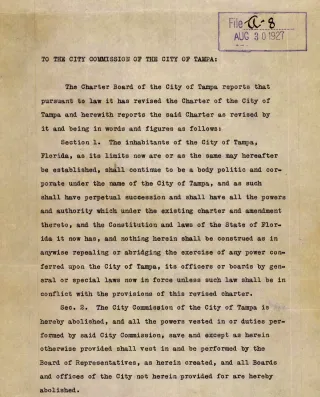
Charter
I’m not going to get too deep into the discussion because we still haven’t seen final language on any of the recommendations — either the CRAC or the ones proposed by council. If you didn’t catch last week’s post and the link to the outline of the Inspector General proposal from CRAC member Bobby Creighton, I recommend you read it. I want to thank him again for taking the time to compile it, particularly in light of the fact that Council are proposing a different version of the IG than what the commission proposed. His piece is less about the commission’s proposal and more of what other cities and counties in Florida have adopted and some of the different models. It will help put what ultimately is put forward in perspective. Without seeing the final language, I agree with what Bobby said during public comment that funding is key. The more independent the body is made, the more important it is that it’s funded with a guaranteed source of revenue. If a mayor or council can simply starve the office of funds, it’s a paper tiger (my words).
The one thing that might not have gotten any attention but definitely caught my ear was the decision by council to pass on a proposal that would have cleaned up some language about residency requirements for city officers (think CFO and Chief of Police, not street patrol officers). Rather than fix the language, Council indicated they wanted to open back up the decision approved in 2024 to remove residency requirements for such positions. The grounds cited were the ballot language used that led with “Should the mayor and city council be required to be residents” which is already in the Charter, and not “Should the Chiefs of Police, Fire Rescue, Finance (I use those because those are named positions in the Charter) and other senior administrators be required to live in the City of Tampa.” Which is what the actual amendment was, it removed the residency requirement for those senior level administrators. It went from a workshop item where the City Attorney had explained that Mayor Jane Castor had applied that requirement to a broad level of departments based on number of reports, not on where they were in the organizational chart. The initial recommendation was an ordinance more clearly defining a narrower subset as “who directly reports to the mayor.”
Instead, Council Chair Alan Clendenin immediately jumped to a Charter amendment removing the requirement at all which passed council and mayoral approval. Then rushed to be on the fall general election ballot that included multiple state amendments including weed and a woman’s right to make choices about their healthcare. Social media was flooded with “Vote Yes on all of the amendments except 5” or some bad amendment. Baffled me at the time many of the same people who are against putting themselves on the ballot in the fall would rush to put a change to the Charter on one. Anyway, I wrote about it back then.
One final note, I’m still confused about discussion of the mayor and veto. The Charter Review Commission ordinance required 5 votes by council to move items forward and if all of the proposed changes not part of the recommendations carry 5 votes (which they did in motions to move forward, most if not all unanimously), I’m not sure there’s anything for the mayor to veto. I suppose she could veto some on principle or not sign them. A quote in the Tampa Bay Times from that the mayor didn’t sound like she’s on board with some of the proposals.
“I am deeply concerned that Council members are now considering changes that would disregard much of that thoughtful work and fundamentally alter the balance of responsibilities that has served Tampa for decades,” Castor said in a statement. “We created this independent citizen-led process for a reason, and its analysis should not be cast aside for a power grab.”
The votes this week aren’t the final votes. This week will be about finalizing the proposals with what should be close to the proposed language. I suspect we’ll get more of a framework on the IG with final, final language in advance of the first public hearing, tentatively scheduled November 5. Final vote tentatively scheduled November 19.
Our stories may be republished online or in print under Creative Commons license CC BY-NC-ND 4.0. We ask that you edit only for style or to shorten, provide proper attribution and link to our website.