
Hillsborough’s Commission May Change. Where Does Tampa’s City Council Stand?
Charter Review Advisory Commission member Bobby Creighton on how Tampa’s council has been carved up since 1887, and why one council member has never represented so many people.
I had the honor of serving as Council Member Lynn Hurtak’s appointee to Tampa’s Charter Review Advisory Commission. I learned a lot over the nine months or so the commission considered various changes to the city’s charter. The purpose of this and future articles in this charter review series is to share some of what I’ve learned with the public. My goal is not to persuade the reader, but to provide insight to future voters on the issues we discussed.
With the general election around the corner, the Hillsborough County Commission may gain five more districts and lose at-large seats. As the debate around how elected officials should represent their constituents heats up, some Tampeños may reasonably wonder how our own elected body serves the citizens. Where does Tampa’s city council stand?
Big changes in the way elected officials map onto the places they serve happen so rarely the status quo can feel immutable. Indeed, Tampa has had seven council members for so long there’s likely very few people alive today who remember it otherwise. For most Tampans, the way our representation works is taken for granted, melding into the unconsidered backdrop of city life.
Like the city itself, Tampa’s city council has changed over time. The number of members has risen and fallen, district boundaries have drastically shifted, and terms have lengthened. While cities can and do run without a “strong mayor” (including Tampa at one point), the City of Tampa cannot exist without a city council.
So where does Tampa’s city council stand? Comparing Tampa’s past council systems and what other cities do can help answer that question.
How Tampa’s City Council has Evolved
-
Town of Tampa established
-
Confederate authorities suspend the town government
-
Municipal government reorganized
-
“No Corporation” People’s Ticket elected to dissolve the city government
-
Town of Tampa re-established
-
Ordinance increases seats from five to nine
-
Town abolished, City of Tampa established: four wards, two members per ward, three members at-large
-
Wards increased from four to nine; two members at-large
-
Wards increased from nine to ten; one member at-large
-
Commission-manager government adopted; five at-large commissioners
-
Commission-manager government abolished; twelve wards; strong mayor restored
-
Council restructured to seven residential at-large districts
-
Four districts added for annexed territory; eleven districts
-
Redistricted back to seven residential at-large districts
-
Four single-member districts; three members at-large
For an undeniably stellar history of Tampa’s City Council, take the time to dive into the City Archive’s Tampa’s City Council and Old City Hall — it is well worth the read. Here are the highlights for how the structure has changed.
In Tampa’s earliest years the town had a board consisting of four or five members. On becoming established as the City of Tampa in 1887 the city was divided into four wards. Two council members represented each ward and three were elected at-large. The number of wards increased in 1908, growing from four to nine with one member per ward and two members elected at-large. The council expanded once again by an additional ward in 1914 and reduced the at-large members to one. Throughout this first period of its life the city maintained eleven council members.
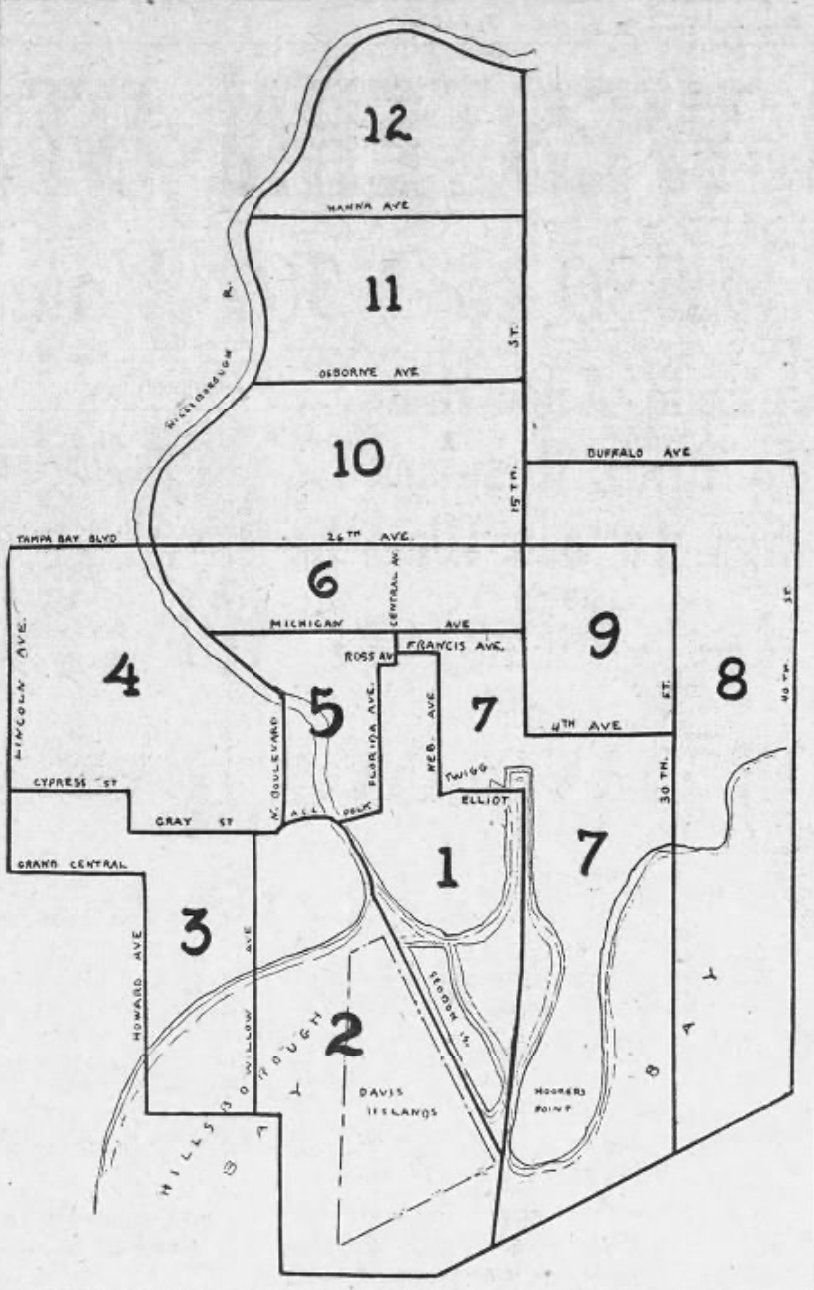
In 1921 Tampa voters replaced the mayor-council system, in which the mayor is the chief executive, with a commission-manager form of government. For seven years, five at-large commissioners governed the city while a city manager performed the administrative functions. The experiment was short-lived. In 1928 voters restored the mayor-council system, and the city was divided into twelve wards with a council member from each.
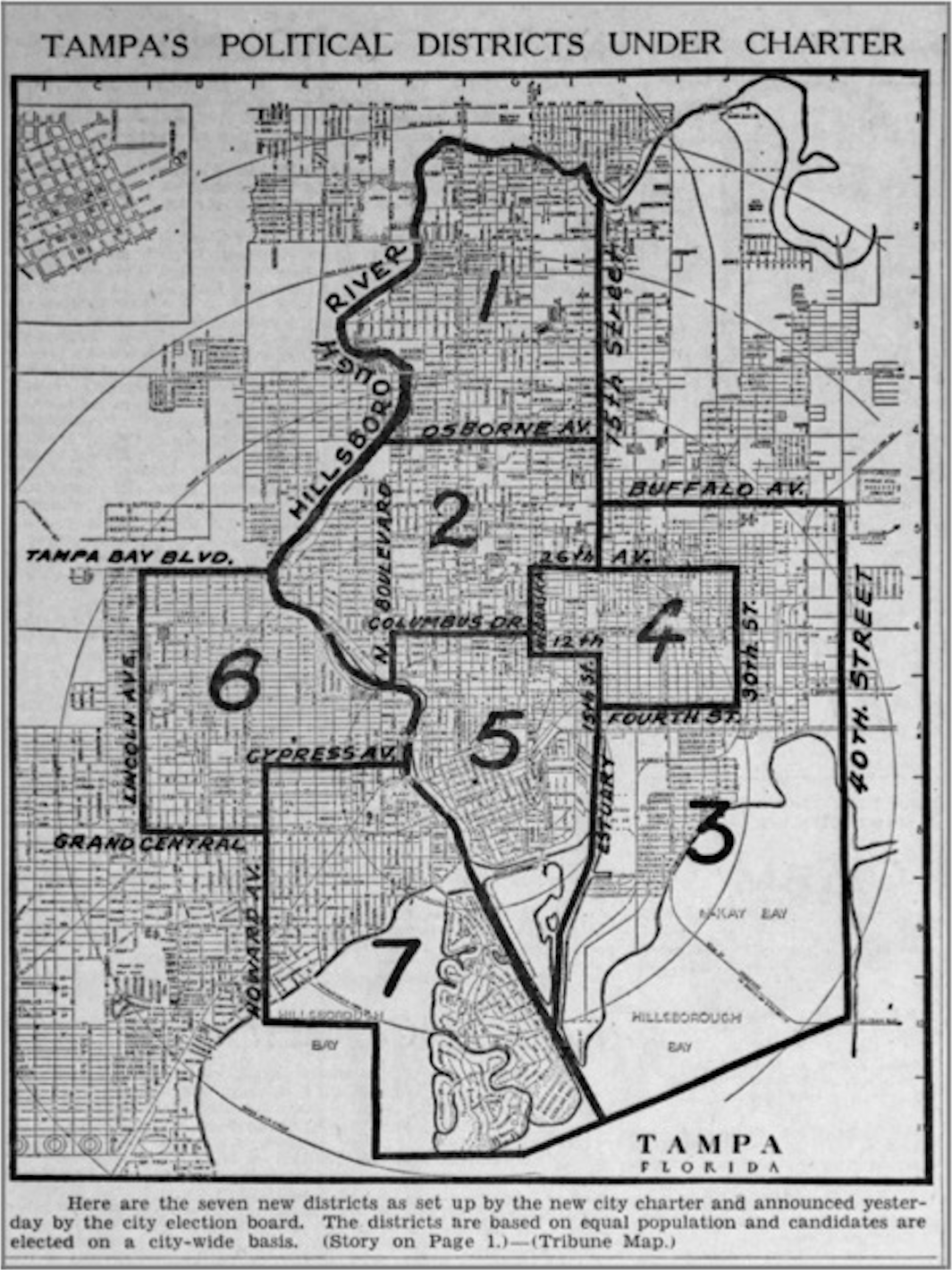
In 1945 the city was redistricted into seven districts with a “residential at-large” system. Council members were required to live within a specific district but appeared on every voter’s ballot. This system remained in place until 1987, when the current mixed configuration replaced it. Today we have four single-member districts which carve the city roughly into north, south, east and west, and three at-large council members who are elected by voters across the entire city.
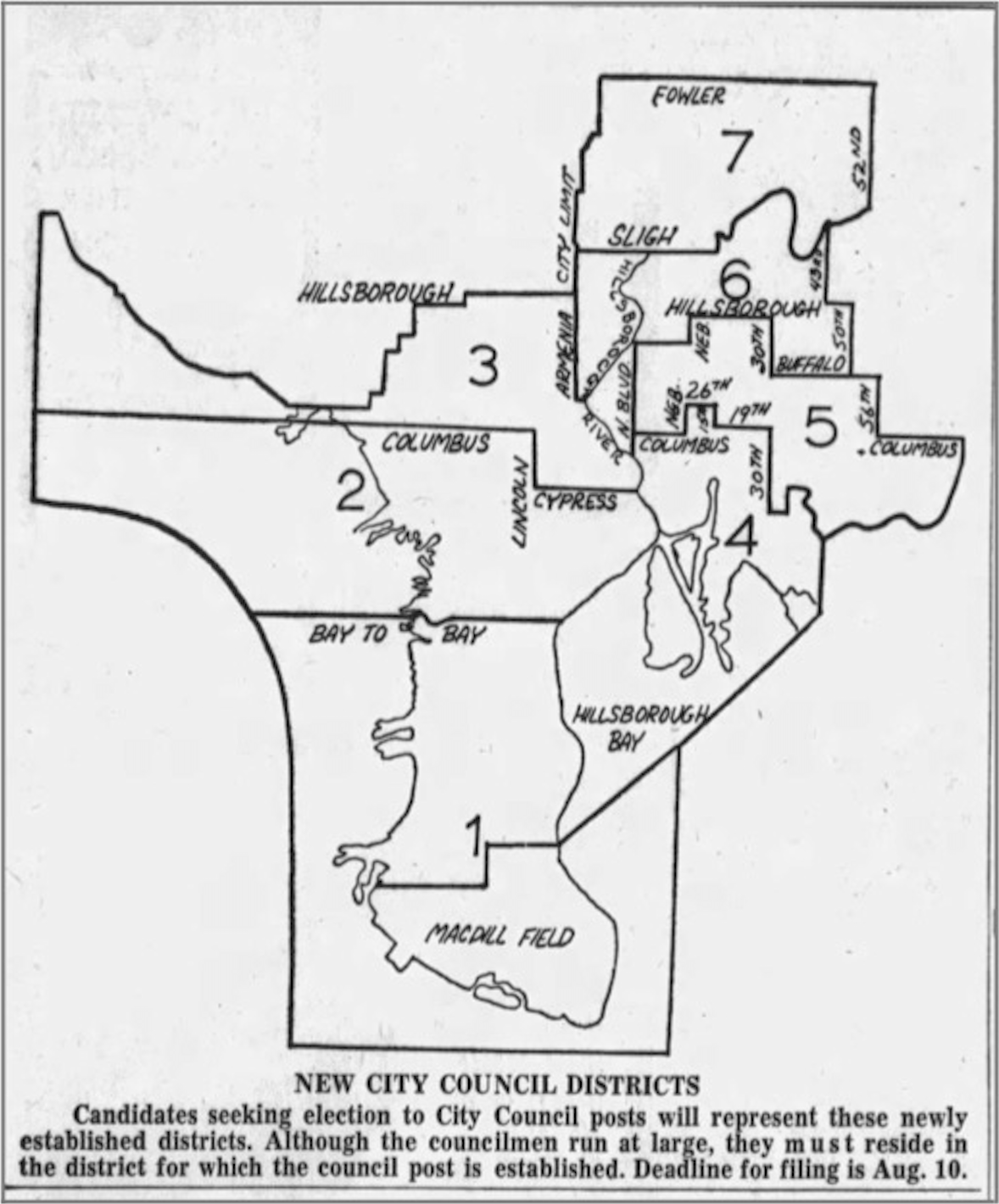
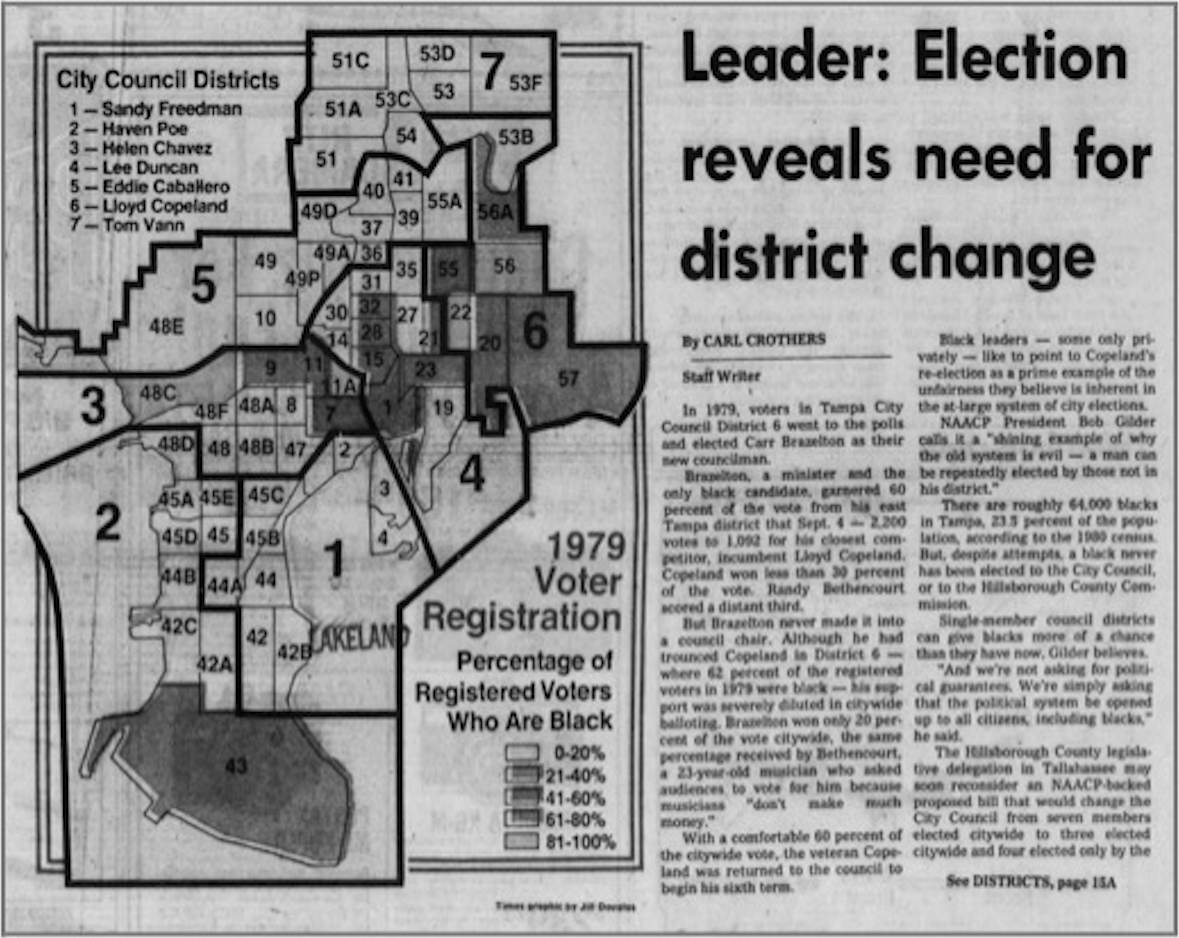
The ward and district lines Tampa used before today’s four districts, traced from newspaper maps onto today’s streets. Pick a year, then click a ward or district for the streets that bound it. The full map has notes on each year’s sources.
How Tampa’s City Council Compares
Census counts for census years; state census for 1905 and 1915; other years interpolated. Data: Bobby Creighton.
Data table
| Year | Constituents per council member | Residents per ward or district | City population |
|---|---|---|---|
| 1887 | 1022 | 1022 | 4088 |
| 1890 | 1383 | 1383 | 5532 |
| 1900 | 3960 | 3960 | 15839 |
| 1908 | 3533 | 3533 | 31798 |
| 1910 | 4198 | 4198 | 37782 |
| 1914 | 4608 | 4608 | 46084 |
| 1920 | 5161 | 5161 | 51608 |
| 1928 | 7604 | 7604 | 91250 |
| 1930 | 8430 | 8430 | 101161 |
| 1940 | 9033 | 9033 | 108391 |
| 1945 | 116536 | 16648 | 116536 |
| 1950 | 124681 | 17812 | 124681 |
| 1953 | 169768 | 15433 | 169768 |
| 1955 | 199826 | 28547 | 199826 |
| 1960 | 274970 | 39281 | 274970 |
| 1970 | 277767 | 39681 | 277767 |
| 1980 | 271523 | 38789 | 271523 |
| 1987 | 69367 | 69367 | 277467 |
| 1990 | 70004 | 70004 | 280015 |
| 2000 | 75862 | 75862 | 303447 |
| 2010 | 83927 | 83927 | 335709 |
| 2020 | 96240 | 96240 | 384959 |
| 2024 | 103637 | 103637 | 414547 |
To compare how council representation works for other cities in Tampa’s league, the Planning Commission provided the charter review committee a sample of 23 cities with a population between 400,000 and 600,000. You can see that report here. Of all the cities in the sample, Tampa had the fewest single-member district seats at four. This spiked the number of constituents per district to about 103,000, the highest of all the cities in the sample. The median number of constituents per single-member district was much lower at only 67,000 — close to what Tampa had when single-member districts were reintroduced in 1987.
The systems cities use also varied. Of the 23 cities included, the majority have a council composed solely of single-member districts. The remaining 10 have some variation of a hybrid system with both single-member and at-large districts. In some of these governments the mayor sits with the city council and the administration is run by a city manager. Interestingly, Kansas City has bi-member districts like Tampa used in 1887. As an aside, a few cities with populations over 600,000 such as Portland and Memphis also use multi-member districts.
The cities in the sample most commonly had seven seats on their city council, consistent with Tampa’s seven seats. About 70% of the cities had nine council members or less. Some cities more than doubled Tampa’s council members, like Atlanta with 16 or Baltimore and Milwaukee with 15. Minneapolis and Kansas City almost doubled Tampa’s seats with 13 and 12 members respectively.
What’s Next?
The debate in the county will soon be settled, but the same propositions apply to local governments everywhere. What is the best ratio of constituents to legislators? How and when should systems be updated? Is there a system that positions elected officials to serve their constituents best? What can we learn from history about how systems have been used to disenfranchise voters so we don’t repeat those same mistakes?
At no point in the city’s history has one council member represented so many constituents, and Tampa’s population is only growing. Every day our urban environment is transforming before our eyes. The Planning Commission projects the city will have 473,000 residents by 2035 and 492,000 by 2050. If council members today had a proportionate number of constituents to their colleagues from 1887, the city would have an assembly of over 400 members. Certain practicalities of efficient government present necessary constraints.
From its own record and from peers around the country, the variety in systems of local representation abounds. Historically, Tampa’s city council has taken on a new form roughly every 20-40 years, trending from more wards and less at-large representation, to only at-large representation, to the mix we have today. What tomorrow’s city council may become only time will tell.
Our stories may be republished online or in print under Creative Commons license CC BY-NC-ND 4.0. We ask that you edit only for style or to shorten, provide proper attribution and link to our website.