
$64 million question
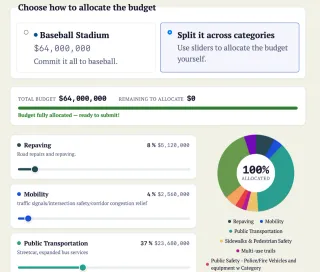
How would you allocate $64 million in extra Community Investment Tax funds? A baseball stadium or…
Set aside Tourist Taxes and tax rebates, the core public funding for the proposed Tampa Bay Rays stadium in Tampa is the use of the Community Investment Tax. The Rays are suggesting the tax will generate more than the $3.5 billion the county estimates the tax will bring in. For Tampa, over the 15 years of the tax the estimated revenue is $783,000,000. As I understand it from listening to Tampa Sports Authority Board Chair Patrick Manteiga, the city and county are estimating an annual growth of 3% which is included in the projected revenue. The Rays are suggesting it will be 4.5% and want the 1.5% off the top. Meaning if growth is less than 4.5%, the city and county would have to cut their budgets to make up the difference.
Assuming the Ray’s projection is correct, I thought it would be interesting to ask readers and the community, “how would you spend an extra 64 million dollars?”
Updated
Responding to a comment on Facebook from Council Chair Alan Clendenin:
“I think what’s missing here is the majority of the revenue anticipated to pay for the project would not materialize without the project. In other words, if we don’t build a stadium, we don’t have the revenue to do this other stuff. ”
Which seems to suggest that if the stadium isn’t built, the “extra” $64 million wouldn’t exist. That somehow the stadium is actually paying for itself. The 0.5% is paid by consumers at the register, not by the team or the businesses. Framing it as “the team’s growth” obscures who actually funds it.
So some math.
The team is requesting $336 million in CIT funds, $64 million from the city.
In order to generate the 1.24% annual growth on the CIT above what’s already been factored in (what would be necessary to generate an extra $336M), it would require generating an extra $67.2B in taxable sales over the 15 years.
$4.5B per year, every year, for 15 years
And if that growth doesn’t happen, the city would still be on the hook for $64 million of CIT funds, cutting into the areas the funds were earmarked for or other areas of need.
One study has shown if the ballpark and the associated mixed-used development is built it would have an “economic impact” of $75 billion over 30 years. Economic impact isn’t the same thing as taxable sales but for argument’s sake that’s only slightly more than half of what is necessary.
I’ll also note IF the $4.5 billion a year is achieved, 3% net profit on $67B is $2 billion.
Put differently: about $200 of new gross sales has to happen for every $1 of “extra” tax revenue the team is counting on, and the businesses producing those sales would keep roughly $6 in net profit for every $1 the stadium gets (at a 3% net margin).
The categories are primarily pulled from existing “buckets” the city has earmarked for CIT funds with the exception of public transportation and stormwater, but I feel confident if there are stadium sized loopholes in how the funds can spent, there’s room for stormwater and streetcar expansion.
The final tally
This post originally carried an anonymous budget-allocation poll; it has closed, and these are the final results. Of 29 submissions, 3 took the all-in option — commit the whole $64 million to a baseball stadium — and 26 split the funds across the categories. The averages below are among those who split.
| Category | Average share | Of $64 million |
|---|---|---|
| Public Transportation | 21.7% | $13.9M |
| Housing | 14.9% | $9.5M |
| Stormwater | 12.0% | $7.7M |
| Parks and Recreation | 11.1% | $7.1M |
| Repaving | 11.0% | $7.0M |
| Sidewalks & Pedestrian Safety | 9.6% | $6.2M |
| Mobility | 8.9% | $5.7M |
| Multi-use Trails | 4.2% | $2.7M |
| Public Safety — Police/Fire Facilities | 3.4% | $2.2M |
| Public Safety — Police/Fire Vehicles & Equipment | 3.2% | $2.0M |
Our stories may be republished online or in print under Creative Commons license CC BY-NC-ND 4.0. We ask that you edit only for style or to shorten, provide proper attribution and link to our website.